Showing posts with label Construction. Show all posts

Thursday, March 21, 2013

North Korea issues fresh threat to U.S. Bases!


SEOUL (Reuters) - North Korea said it would attack U.S. military bases on Japan and the Pacific island of Guam if provoked, a day after leader Kim Jong-un oversaw a mock drone strike on South Korea. The North also held an air raid drill on Thursday after accusing the United States of preparing a military strike using bombers that have overflown the Korean peninsula as part of drills between South Korean and U.S. forces. North Korea has stepped up its rhetoric in response to what it calls "hostile" drills between South Korea and the United States. It has also been angered by the imposition of fresh U.N. sanctions that followed its February 12 nuclear test. Separately, South Korea said a hacking attack on the servers of local broadcasters and banks on Wednesday originated from an IP address in China, raising suspicions the intrusion came from North Korea.

"The United States is advised not to forget that our precision target tools have within their range the Anderson Air Force base on Guam where the B-52 takes off, as well as the Japanese mainland where nuclear powered submarines are deployed and the navy bases on Okinawa," the North's supreme military command spokesman was quoted as saying by the KCNA news agency.  Japan and U.S. Pacific bases are in range of Pyongyang's medium-range missiles. It is not known if North Korea possesses drones, although a report on South Korea's Yonhap news agency last year said it had obtained 1970s-era U.S. target drones from Syria to develop into attack drones. "North Korea has strongly stepped up development of asymmetrical strategy with nuclear development and many types of ballistic missiles as well as a special forces of 200,000 strong."  MadOne

Tuesday, February 19, 2013

North Korea threatens South with 'final destruction'

An activist from an anti-North Korea civic group burns a portrait of North's leader Kim Jong-un during a rally against North Korea's nuclear test near the U.S. embassy in central Seoul February 12, 2013. North Korea conducted its third nuclear test on Tuesday in defiance of U.N. resolutions, angering the United States and Japan and prompting its only major ally, China, to call for calm. The poster (front R) reads, "Let's pulverize North Korea's nuclear war provocations!"  REUTERS/Kim Hong-Ji (SOUTH KOREA - Tags: CIVIL UNREST POLITICS TPX IMAGES OF THE DAY)  


GENEVA (Reuters) - North Korea threatened South Korea with "final destruction" during a debate at the United Nations Conference on Disarmament on Tuesday, saying it could take further steps after a nuclear test last week. Jon's comments drew quick criticism from other nations, including South Korea, France, Germany and Britain, whose ambassador Joanne Adamson said such language was "completely inappropriate" and the discussion with North Korea was heading in the wrong direction. 

"In the 30 years of my career I've never heard anything like it and it seems to me that we are not speaking about something that is even admissible, we are speaking about a threat of the use of force that is prohibited by Article 2.4 of the United Nations charter," Catalina said. Since the North tested a nuclear bomb last week in defiance of U.N. resolutions, its southern neighbour has warned it could strike the isolated state if it believed an attack was imminent. Pyongyang said the aim of the test was to bolster its defences given the hostility of the United States, which has led a push to impose sanctions on North Korea. "If the U.S. takes a hostile approach toward the DPRK to the last, rendering the situation complicated, it (North Korea) will be left with no option but to take the second and third stronger steps in succession," he said, without indicating what that might entail. North Korea has already told key ally China that it is prepared to stage one or two more tests this year to force the United States into diplomatic talks, a source with direct knowledge of the message told Reuters last week.

Impoverished and malnourished North Korea is one of the most heavily sanctioned states in the world. It is still technically at war with South Korea after a 1950-53 civil war ended in a mere truce.
Washington and its allies are believed to be pushing to tighten the noose around North Korea's financial transactions in a bid to starve its leadership of funding. Jon said last week's test was an act of self-defence against nuclear blackmail by the United States, which wanted to block North Korea's economic development and its fundamental rights. Jon said the United States had conducted most of the nuclear tests and satellite launches in history, and he described its pursuit of U.N. Security Council resolutions against North Korea as "a breach of international law and the height of double standards".

Neither Russia nor China, which are veto-wielding members of the U.N. Security Council, spoke at Tuesday's meeting in Geneva. Before its nuclear test, North Korea was already facing growing diplomatic pressure at the United Nations. The U.N. Human Rights Council is widely expected to order an inquiry next month into its leaders' responsibilities for crimes against humanity. MadOne

Tuesday, May 22, 2012

100-Year Starship Project Forges Ahead With First Round of Funding


An ambitious effort for an interstellar travel planning organization officially kicked off this week, after DARPA awarded $500,000 to form the 100-Year Starship initiative. Former astronaut Mae Jemison, whose proposal was selected earlier this year, will lead the new independent organization. The goal is to ensure that the capability for human interstellar travel exists within the next 100 years. It may not look like the starship Enterprise, but a real interstellar vessel is possible within that timeframe, Jemison said. “Yes, it can be done. Our current technology arc is sufficient,” she said in a statement.

In its first year, the organization will seek new investors and develop new ideas for interstellar exploration, the new 100YSS website says. A public symposium is planned for September in Houston, where anyone from engineers to philosophers will be able to present papers and host talks about the challenges of such a project. The 100-Year Starship is not necessarily a ship per se, but an organization that can last 100 years and potentially carry out the vision of a real starship. It will look for input from scientists, engineers, doctors, sociologists, writers (!), ethicists and public policy experts. The 100-Year Starship project also has a new scientific research partner called The Way, an awesomely named spinoff that will focus on “speculative, long-term science and technology,” according to the project. We can't wait to see what they come up with. Popsci

Monday, June 20, 2011

Iraq hunting $17 billion missing after U.S. invasion


BAGHDAD (Reuters) – Iraq's parliament is chasing about $17 billion of Iraqi oil money it says was stolen after the 2003 U.S.-led invasion and has asked the United Nations for help to track it down. The missing money was shipped to Iraq from the United States to help with reconstruction after the ouster of Saddam Hussein. In a letter to the U.N. office in Baghdad last month, parliament's Integrity Committee asked for help to find and recover the oil money taken from the Development Fund of Iraq (DFI) in 2004 and lost in the chaos that followed the invasion.

"All indications are that the institutions of the United States of America committed financial corruption by stealing the money of the Iraqi people, which was allocated to develop Iraq, (and) that it was about $17 billion," said the letter sent to the U.N. with a 50-page report. The committee called the disappearance of the money a "financial crime" but said U.N. Security Council resolutions prevent Iraq from making a claim against the United States.
"Our committee decided to send this issue to you ... to look into it and restore the stolen money," said the letter, a copy of which was obtained by Reuters.

U.N. officials were not immediately available for comment.

Monday, June 13, 2011

More than $6 billion in Iraq reconstruction funds lost


The Iraqi and U.S. governments have been unable to account for a substantial chunk of the billions of dollars in reconstruction aid the Bush administration literally airlifted into the country. If the cash proves to have been stolen, the heist could represent "the largest theft of funds in national history," according to a report in the Los Angeles Times. 

Pentagon officials determined that one giant C-130 Hercules cargo plane could carry $2.4 billion in shrink-wrapped bricks of $100 bills. They sent an initial full planeload of cash, followed by 20 other flights to Iraq by May 2004 in a $12-billion haul that U.S. officials believe to be the biggest international cash airlift of all time.

Special inspector general for Iraqi reconstruction Stuart Bowen told the paper the missing $6.6 billion may be "the largest theft of funds in national history."
Iraqi officials say it was the U.S. government's job to keep track of the funds, which were brought in as an emergency measure to keep basic infrastructure going after Saddam Hussein's ouster. House Government Reform Committee investigators found in 2005 evidence of "substantial waste, fraud and abuse in the actual spending and disbursement of the Iraqi funds."
Witnesses testified that millions of dollars were shoved into "gunnysacks" and disbursed to Iraqi contractors on pick-up trucks, with what seemed to be little financial controls or accounting on the part of the U.S. government. MadOne

Tuesday, May 24, 2011

Plan in works for 500-foot, $100M Las Vegas wheel

Aritst drawing of Skyview Super Wheel

LAS VEGAS – A developer is rolling out plans to build a 500-foot viewing wheel on the Las Vegas Strip that would be higher than the London Eye and give visitors an unparalleled view of Sin City. Developer Howard Bulloch of Compass Investments released details of the project Monday to reporters, local lawmakers and business leaders at the site across Las Vegas Boulevard from the Mandalay Bay hotel-casino. Bulloch wants the Skyvue Las Vegas Super Wheel to open in 2013 as part of a $100 million privately funded project also including a roller coaster and 200,000 square feet of retail, restaurant and entertainment space.


Tuesday, May 17, 2011

Ideas Wanted for 100-Year Starship Project by DARPA, NASA


"The 100-Year Starship Study is a project seeded by DARPA to develop a viable and sustainable model for persistent, long-term, private-sector investment into the myriad of disciplines needed to make long-distance space travel practicable and feasible," the DARPA request reads.

NASA's Ames Research Center is collaborating with DARPA on the $1 million study, which should be completed by the end of the year. The two organizations want suggestions for how best to structure, manage and fund a project that must last at least 100 years. And that's where last week's request comes in. "The respondent must focus on flexible yet robust mechanisms by which an endowment can be created and sustained, wholly devoid of government subsidy or control, and by which worthwhile undertakings — in the sciences, engineering, humanities, or the arts — may be awarded in pursuit of the vision of interstellar flight," DARPA officials explained. 


DARPA's deadline for suggestions is June 3. The agency said it does not anticipate awarding a contract based on the information it receives this time around. The 100-Year Starship project aims to enable a manned journey between the stars sometime in the next century or so. Space.com

Monday, May 9, 2011

Aircraft carriers gain clout in naval power

ABOARD THE CHARLES DE GAULLE – Despite growing controversy about the cost and relevance of aircraft carriers, navies around the world are adding new ones to their inventories at a pace unseen since World War II.

The U.S. — with more carriers than all other nations combined — and established naval powers such as Britain, France and Russia are doing it. So are Brazil, India and China — which with Russia form the BRIC grouping of emerging economic giants.

The 42,000-ton nuclear-powered carrier has been joined in this task by another smaller ship, Italy's 14,000-ton Giuseppe Garibaldi. None of the U.S. Navy's supercarriers have been involved, despite American participation in the war's initial phase. The U.S. Navy still operates 11 nuclear-powered carriers, mostly Nimitz-class vessels displacing up to 100,000 tons.


The U.S. Navy is scheduled to induct the Gerald R. Ford, the lead ship of a new class three-ship class of supercarriers, in 2015. Each is expected to cost about $9 billion.

Friday, May 6, 2011

Four Companies at Forefront of Commercial Space Race

Four private companies are the leaders in the effort to build commercial spaceships to carry astronauts to low-Earth orbit and the International Space Station after the space shuttles retire. The four contract winners are Blue Origin, Sierra Nevada, SpaceX and Boeing. While the timeline is murky, officials say the earliest a commercial spacecraft would be ready to carry crews to orbit is around 2014-15.


The firms are at various stages of development; SpaceX is the only one that has flown its version of an orbital spacecraft on a test flight. 


Boeing is developing a capsule called the Crew Space Transportation-100 (CST-100), which would be compatible to fly atop various rockets, including SpaceX's Falcon 9 and United Launch Alliance's Atlas and Delta boosters.


Sierra Nevada is building a space plane called Dream Chaser that would launch atop an Atlas rocket like a capsule but glide down for landing like a plane or the space shuttle


Rounding up the group is Blue Origin, a company founded in 2000 by Amazon.com founder Jeff Bezos. Blue Origin is the most secretive of the space companies, keeping specifics of its spacecraft and timeline under wraps.

The four companies are hoping NASA won't be the only customer looking to buy passage aboard their orbital spacecraft. They intend to sell seats to space tourists as well as to astronauts from countries without their own space vehicles. Space.com

Tuesday, April 26, 2011

Space Tourism Business Could See Orbital Boom

Sierra Nevada Corp Dream Chaser

Orbital space tourism is a niche industry at the moment, but business could really boom if costs come down by a couple of orders of magnitude, a new study asserts. To date, only seven people -- beginning with multimillionaire businessman Dennis Tito in April 2001-- have paid to launch into Earth orbit, and they've reportedly plunked down between $20 million and $35 million for the experience. Those are not the numbers of a thriving industry. But things could change dramatically if prices drop significantly -- down to about $500,000 per seat or so. That reduced rate could lure in hundreds of thousands of customers for orbital tourist trips, potentially generating revenues in excess of $100 billion per year, according to the study.

Just last week, for example, the space agency doled out nearly $270 million to four companies — Blue Origin, Boeing, Sierra Nevada Corp. and Space Exploration Technologies (SpaceX) — for this very purpose. NASA wants private industry to start carrying cargo and crew to space as soon as possible, in the wake of the space shuttle program's retirement later this year. This new race to orbital space could help drive costs down substantially, through competition and the development of new, more efficient techologies. But only time will tell if prices drop -- and if so, how much and how fast.

Still, all signs point toward the dawn of a new era in human spaceflight, experts say. NASA's effort to encourage private companies to develop their capabilities could open the heavens to more and more folks who don't have $30 million lying around. Space.com

Monday, January 24, 2011

Private Sector Wants Mining Bases On the Moon


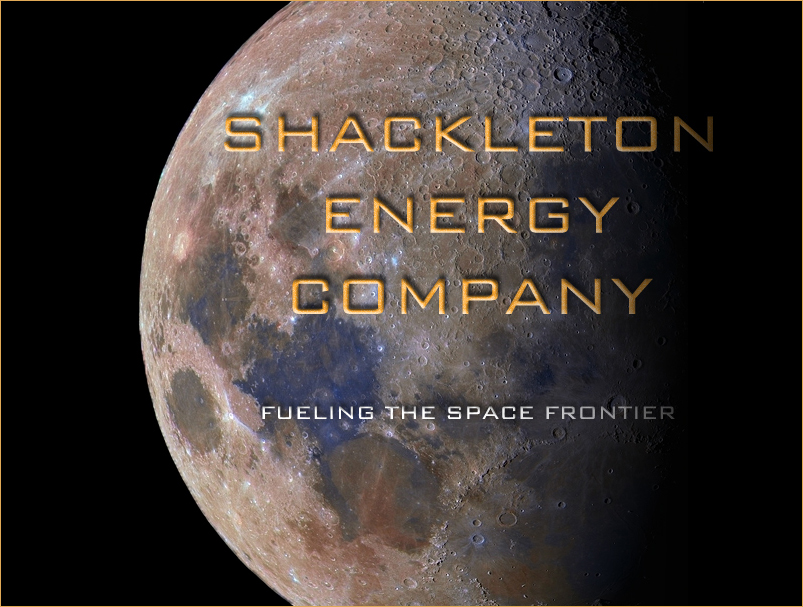
The Shackleton Energy Co. wants to mine the moon's water ice and turn it into rocket fuel. Shackleton Energy Co. (SEC), which was formed in 2007, would sell the propellant from fueling stations in low-Earth orbit (LEO). Because spaceships burn so much fuel just lifting off from Earth, letting them top up in orbit could spur a huge wave of travel and discovery in space, according to SEC founder Bill Stone. And it makes sense to supply the filling stations from the moon, since it's about 15 times cheaper to launch something to LEO from there than from Earth, Stone added.

  "In our view, the moon is a stepping stone," Stone told SPACE.com. "What we extract from there will enable the exploration of the inner solar system."

SEC's mining bases would likely be at one or both lunar poles, in craters whose frigid depths have trapped lots of water over the past several billion years. Craters like Cabeus, perhaps, where water ice makes up 5.6 percent of the lunar dirt by weight. Six to eight people might oversee the mining operations in any one location, according to Stone. Initially, these crews might have to stay for a year, but future base dwellers would likely sign on for six-month stints. These crews would live in inflatable habitat modules. Human-tended robots would perform most of the mining, transportation and processing of water ice into fuel. The processing step would take place up in LEO, where huge shipments of water would be converted to rocket propellant, Stone said. 


SEC has received lots of interest from investors and is making steady progress, according to Stone. The company intends to send robotic scouting missions to both poles within four years, Stone added, with sales of propellant in LEO following shortly thereafter. "By the end of the decade, there's a high likelihood we'll be up and running," Tietz told SPACE.com. SEC may not be the only private enterprise operating on the moon in 10 years or so. Bigelow Aerospace is considering setting up lunar bases, too. Bigelow designs and builds inflatable space habitats, and SEC may well get its modules from Bigelow, Stone said. Bigelow has already deployed two prototype inflatable modules in space, and last year the company signed deals with six clients interested in using the structures. Space.com

Saturday, January 15, 2011

Tianjin Eco-City In China: The Future Of Urban Development?


Green building is becoming so prevalent these days that it may not be enough to erect individual eco buildings anymore - the newest trend is entire eco-cities. Expected to be up and running in 2020, Tianjin Eco-City is one of these real-life sustainable communities, spanning 30 square kilometers and showcasing the hottest energy-saving technologies. Designed by Surbana Urban Planning Group, the city will have an advanced light rail transit system and varied eco-landscapes ranging from a sun-powered solarscape to a greenery-clad earthscape for its estimated 350,000 residents to enjoy. Huffington Post

To the north of the Lifescape, the Solarscape will act as the administrative and civic center of the Eco-City.

Demonstrating the concept of a compact, multilayered city, the Urbanscape will be the core of the Eco-City, featuring stacked programs interconnected by sky-bridges at multiple levels to make efficient use of vertical space.

An aerial view of the Urbanscape.

In contrast to the Urbanscape, the Earthscape will act as a sort of suburb of the city, with stepped architecture that will maximize public green space.

Friday, November 26, 2010

Russia Wants Nuclear-Powered Spaceships and Space Debris Shields


Russia has begun some ambitious space projects, including a new system to protect spacecraft from space junk and a nuclear-powered engine for future spaceships, according to Russian news reports. 

Space junk is such a risk that Russia is also reportedly developing a $2 billion spacecraft that would sweep the orbital space around Earth from satellite debris, according to China's state-run Xinhua news service and Russia's Interfax news agency.

Another project to develop nuclear-powered spaceships will also be a complex undertaking.
Officials from Russia's main space contractor, RSC Energia, said on Tuesday the company is planning to start working on space modules with nuclear-powered propulsion systems next year, and the first launches of such modules could come in 2020, according to Ria Novosti. Russia is also reportedly targeting a moon- or Mars-based nuclear power station, according to the newspaper. That station could operate for 10 to 15 years, Russian space officials said. Space.com

Friday, November 19, 2010

Satellite appears to show NKorea nuke building

SEOUL, South Korea – New satellite images show construction under way at North Korea's main atomic complex, apparent proof that Pyongyang is making good on its pledge to build a nuclear power reactor, according to a private American security institute. North Korea vowed in March to build a light-water reactor using its own nuclear fuel, and two American experts who recently visited the North have reportedly said that construction has begun.


North Korea is pursuing an arsenal of atomic weapons, so all its nuclear projects are of intense interest to its neighbors and to the United States. It carried out nuclear tests in 2006 and 2009, drawing international condemnation and U.N. sanctions.
The Washington-based Institute for Science and International Security on Thursday released commercial satellite images from Nov. 4 that show a rectangular structure being built, with at least two cranes visible at the complex. It estimated North Korea was constructing a 25 to 30 megawatt light-water reactor.  MadOne

Wednesday, November 17, 2010

Bird's-eye view from Space Station

Lights of Italy and Sicily island

The International Space Station's Cupola window bay provides dazzling new views of Earth.

Upper Nile Valley and Egypt at Night

External View of Cupola observatory

The Cupola is an ESA-built observatory module of the International Space Station (ISS). Its seven windows are used to conduct experiments, dockings and observations of Earth. It was launched aboard Space Shuttle mission STS-130 on 8 February 2010 and attached to the Tranquility (Node 3) module. With the Cupola attached, ISS assembly reached 85 percent completeness. The cupola is the largest window ever used in space.

Astronaut in the observatory
Picture of Astronauts space walk

The Cupola provides an observation and work area for the ISS crew giving visibility to support the control of the space station remote manipulator system and general external viewing of Earth, celestial objects and visiting vehicles. Its name derives from Italian word cupola, which means dome.

Monday, November 15, 2010

In Race for Private Space Stations, It's U.S. Versus Russia


A new space race is beginning, but this time between private companies, not nations. Businesses in the United States and Russia are vying to be the first to launch a private space station.
One project, an inflatable space habitat, already has six clients waiting for it, according to the company, Bigelow Aerospace of Las Vegas. 

The other venture, led by two companies in Russia, is called the Commercial Space Station and aims to be a combination laboratory and hotel. Both the CSS and the Bigelow station are looking to launch in the next five years or so. Space.com

Monday, October 25, 2010

Virgin Galactic Spaceship Christens New Spaceport Runway

The Virgin Galactic suborbital vehicle SpaceShipTwo, called Enterprise, soars over New Mexico's Spaceport America terminal – still under construction – under the belly of its huge mothership WhiteKnightTwo during the spaceport’s runway dedication ceremony on Oct. 22, 2010.
UPHAM, N.M. – A new private spaceship designed to carry tourists to space touched down for the first time Friday (Oct. 22) on the runway of Spaceport America, soon to become its home base. Spaceport America is touted as the world's first purpose-built commercial spaceport, and will serve as the headquarters for Virgin Galactic's suborbital spacecraft once the spaceport is complete. A giant hangar and other facilities are still under construction. To mark the dedication of Spaceport America, officials announced the main runway will be named "The Governor Bill Richardson Spaceway" after the current governor of New Mexico.


While SpaceShipTwo is designed to make short joyrides to suborbital space, Virgin Galactic has set its sights on orbital travel, too.
"Obviously, we want to move on to orbital after we've got suborbital under our belts, and maybe even before that," Branson said.
"I can't wait for our first day of commercial operations here," said Virgin Galactic founder and British billionaire Sir Richard Branson. "Today is very personal as our dream becomes more real."
Branson and his family are set to be the first passengers aboard SpaceShipTwo when it begins official operations in nine to 18 months, he said. After them, the line of people waiting for a ride is growing. More than 380 customers have already put down a total of over $50 million in deposits toward SpaceShipTwo flights.
[Video: SpaceShipTwo's First Solo Glide Test.]

Friday, October 22, 2010

Moon Crater Has More Water Than Parts of Earth


A frigid crater at the moon's south pole is jam-packed with water ice, with some spots wetter than Earth's Sahara desert, boosting hopes for future lunar bases. 
That's the picture painted by six new studies that analyzed the intentional moon crash of a NASA spacecraft on Oct. 9, 2009. The agency's LCROSS probe was looking for signs of water when it smashed into Cabeus crater at the moon's south pole last year, and the spacecraft found plenty of it, as scientists announced last year. 


Water ice makes up about 5.6 percent of the total mass on the floor of Cabeus — making the crater about twice as wet as Sahara Desert soil, according to LCROSS mission principal investigator Tony Colaprete.

The high concentration of water ice came as a bit of a shock to mission scientists. This moon water ice is also relatively pure, the researchers found. The original source of much of the material is likely asteroid or comet impacts, scientists said. Once they arrived, the compounds could have moved all over the lunar surface — liberated from the dirt by micrometeorite strikes or solar heating — until they hit a cold trap like Cabeus. The high concentration of water ice at the bottom of Cabeus is good news for anyone pushing for bases at the moon's poles.

Future moon-dwellers could conceivably mine such large quantities of ice efficiently. They could it process it into its constituent hydrogen and oxygen, prime ingredients of rocket fuel. And they could melt the ice down and drink it — provided they remove some of the nasty stuff, like mercury. Space.com

Wednesday, October 6, 2010

Swiss inch toward world's LONGEST TRAIN TUNNEL.


Gotthard Base Tunnel in Switzerland.
The tunnel has been under construction since 1993, and upon its scheduled completion at the end of 2017, it will span 35 miles -- the longest rail tunnel on the planet.
The current title belongs to Seikan Tunnel in Japan. Completed in 1988, it stretches 33.49 miles, a large portion of which is underwater. The world-famous Channel Tunnel (aka “the Chunnel”) measures 31.4 miles. While those two tunnels go underwater, the Swiss tunnel will zoom through the Alps, traveling between Zurich and Milan in about two and a half hours.
Such incredible feats of engineering may lead some to wonder how tunnels are made.Yahoo.com.


Think about it for a second, if they can build a 35 mile tunnel under Mountains and under water in Japan. What else are these companies or governments capable of building underground. Better yet, how deep they have been inside the earth. These massive tunnel systems could be right under our very feet, 35 miles below the entire united states or the world for that matter. By far this is not far fetched and very possible and likely. Read into it. Power your Mind! MadOne.